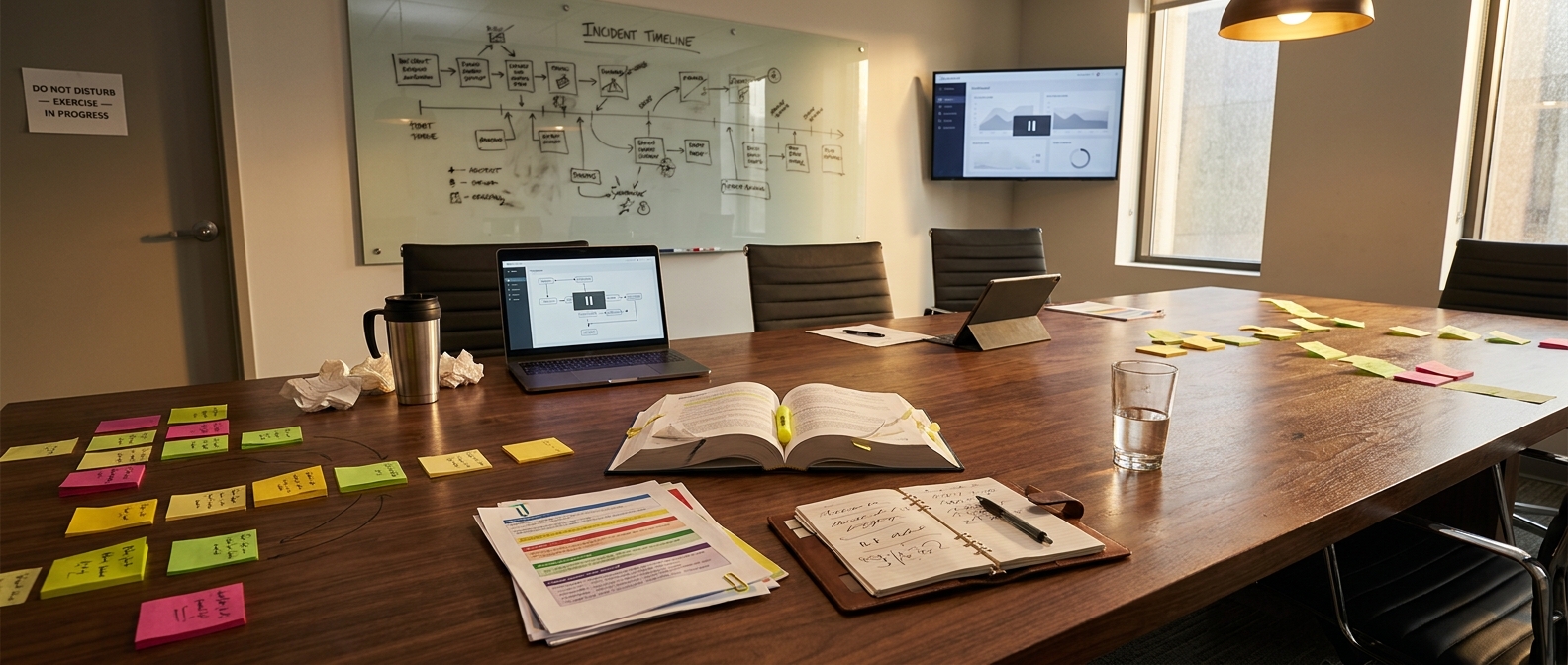
It's Tuesday morning and your IT team gets an alert. Your network has been breached. Customer data may be compromised. Your systems are locked. Who do you call first? What do you say publicly? How do you contain the damage? Where is the plan? What's my role?
If your team is scrambling to answer those questions when an incident hits, it's already too late. The organizations that weather cyberattacks with their reputations and operations intact are the ones that prepared long before the crisis. That preparation starts with a Security Tabletop Exercise.
What is a Security Tabletop Exercise?
A Security Tabletop Exercise is a structured, discussion-based simulation where your team works through a realistic security incident scenario in a controlled, low-stakes environment. Think of it as a fire drill for your IT security and incident response capabilities.
Guided by experienced security facilitators, your team confronts simulated crises like ransomware attacks, insider threats, and supply chain compromises. During the exercise, your team makes real decisions about containment, communication, escalation, and recovery. No live systems are touched, but the lessons are very real.
The question isn't if your organization will face a security incident.
It's when. And whether you've practiced for it.
The cost of being unprepared
The stakes of inadequate incident preparedness have never been higher. Ransomware, phishing campaigns, insider threats, and supply chain attacks are increasingly sophisticated, and no organization is immune.
Without rehearsals, teams make unpredictable and costly mistakes during incidents. Communication breaks down across departments. Critical decisions get delayed. Responders duplicate efforts or miss key steps. Regulatory obligations go unmet. The result? Longer recovery times, larger financial losses, and serious reputational damage.
Five reasons tabletop exercises are critical
1. They expose gaps before attackers do.
The most valuable outcome is often what you didn't know. When teams work through a scenario, hidden weaknesses in policies, procedures, and tools come to the surface. A thorough post-exercise gap analysis turns those discoveries into actionable recommendations, giving you a roadmap to strengthen your defenses before a real attacker finds the same gaps.
2. They build muscle memory across teams.
Incident response is a team sport. IT, HR, legal, communications, and leadership all play critical roles, and they rarely train together. Tabletop exercises break down those silos and build the cross-departmental coordination that's essential when seconds count. When a real crisis hits, your people will default to what they've practiced, not what's written in a document.
3. They accelerate incident response times.
Speed matters enormously during a security incident. Every hour of hesitation can mean more data exfiltrated, more systems encrypted, more customers affected. Teams that have rehearsed their response plans respond faster, communicate more clearly, and make better decisions under pressure. The repetition of tabletop training translates directly to faster containment and recovery in real-world events.
4. They support regulatory compliance.
Many industries now require documented incident response testing as part of regulatory compliance, including healthcare (HIPAA), finance (FFIEC, GLBA, SOC 2, PCI DSS), and government contractors (NIST, CMMC). A well-facilitated tabletop exercise, followed by a detailed report, provides evidence of your proactive security posture and helps meet those mandates before auditors come knocking.
5. They create a culture of security preparedness.
Organizations that conduct regular tabletop exercises send a powerful message internally. Security is a shared responsibility, and everyone has a role to play. Over time, this builds a culture of preparedness where teams think proactively about risk, communicate security concerns early, and treat incident response as an ongoing competency rather than a box to check.
What a professional tabletop exercise looks like
A high-quality tabletop exercise isn't a generic checklist. It's a customized, end-to-end engagement.
Phase 1: Pre-exercise consultation
Before the exercise begins, Digital Elevation works to understand your specific concerns, threat landscape, and regulatory environment. Realistic scenarios are built around your industry, whether you're in healthcare, finance, retail, or another sector, and key participants are identified across all relevant departments.
Phase 2: Exercise facilitation
Experienced facilitators guide your team through the simulated incident, prompting discussion and real-time decision-making at every stage. Scenarios adapt dynamically based on your team's responses, mirroring the unpredictable nature of actual attacks. This isn't a lecture; it's an immersive, interactive experience.
Phase 3: Post-exercise analysis
After the exercise, a thorough debriefing session reviews what went well and where gaps emerged. A detailed written report then provides specific, prioritized recommendations to improve your policies, procedures, and response plans, giving your leadership team a clear path forward.
Scenarios that reflect real-world threats
Advanced tabletop exercises can simulate ransomware attacks, insider threats, supply chain compromises, and industry-specific scenarios, ensuring your team is prepared for the threats most likely to target your organization.
The only thing more expensive than a security incident is being unprepared for one.
Don't wait for a real crisis to find out
Tabletop exercises are one of the most cost-effective investments an organization can make in its long-term security posture. They highlight vulnerabilities, align teams, satisfy compliance requirements, and most importantly, give your people the confidence and clarity to act decisively when it matters most.
The question isn't whether your organization can afford to run a tabletop exercise. The question is whether you can afford not to.
Ready to strengthen your security posture?
Digital Elevation's Security Tabletop Exercise service delivers expert facilitation, industry-specific scenarios, and actionable post-exercise reporting tailored to your organization's unique needs. Our team is ready to help you build a resilient, prepared organization.
Schedule a tabletop exercise arrow_forwardW. Scott Montgomery leads incident response and tabletop exercise engagements at Digital Elevation.